THE LOSS
THE DESTRUCTION OF THE FAITH COMMUNITY
Like all those Catholics actively practicing their faith in a church which is slated to be closed, the parishioners of St. Peter are discouraged and depressed. Our churches are second homes and our fellow parishioners are extended family.
As we become closer to God, we become closer to other parishioners as well. God works for all of us, through all of us.
As our active faith communities are destroyed they do not simply shift to a new church...they disappear. With the destruction of the faith community, all the closeness, camaraderie and the growing together by virtue of our shared faith is lost. The friendships made, the breakfasts and gatherings after Mass, the parish picnics and other events, the service on committees and councils, and as lectors, eucharistic ministers and religious instructors are all now irrelevant. Twenty years of First Friday Eucharistic Adacation for vocations, also irrelevant. Perhaps most sad is the affront to the heroic efforts by our founders in building our sacred place of worship. Again...irrelevant.
What is the choice of our parishioners? Abandon their faith?
Abandon active participation in Mass by resorting to the television or internet? Or, with no desire to participate, find a new spiritual home outside of the new, planned mega-church. Or transition to the new mega-church to attend but not participate?
When will our feelings of loss and despair end? In how many years? Sadly, with the closure of St. Peter Church, those attending Mass there will most likely join the great majority of church-going Catholics who, while attending weekly mass do not actively participate in the social or community activities of their new church.
THE LOSS OF EVANGELIZATION
A question arises as to whether larger churches serve the convenience of church administration at the expense of evangelization and the ultimate goal of the Roman Catholic Church...the salvation of souls.
The Archdiocese of Hartford has assumed that closing St. Peter and the other two (2) churches will strengthen the Catholic community and enable evangelization. But how? The establishment of larger churches amid the destruction of smaller churches demoralizes the faithful and encourages the adoption of an in-and-out attitude among practicing Catholics. Their practice becomes limited to attendance at vigil and Sunday masses. The commitment that comes from participation in church activities is limited as the larger congregations require less participation by parishioners.
Smaller churches survive only when the majority of their parishioners serve in some manner. Evangelization originates in this active participation.
As parishioners pray together, work together and enjoy parish activities together, evangelization thrives and spreads into 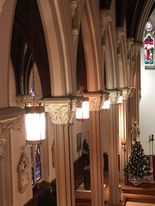 the community. The parishioners of St. Peter Church exemplify this evangelization. the community. The parishioners of St. Peter Church exemplify this evangelization.
Located on the edge of the center of New Britain on Franklin Square, the parishioners of St. Peter offer the poor and homeless a Morning Mingle breakfast on Friday mornings and a dinner on Tuesday evenings. This service is unique among the Catholic Churches in New Britain. An apostolate for deaf Catholics has also developed.
Evangelization is not advanced by closing the one Catholic Church in New Britain which follows the Gospel mandate and feeds the poor and homeless. All of New Britain suffers as well when this flame of evangelization is snuffed out.
THE LOSS OF INSPIRATION
St. Peter Church is not a building. St. Peter Church is a sacred house of worship sanctified by the prayers of generations of Catholics. Within its walls and surrounded by stained glass windows from Munich depicting the life of Christ, the faithful have transformed their lives through prayers. Its loss is irreparable. Compact but vertical, St. Peter Church is French-German Gothic with its majestic vaulted ceiling.
Founded by German immigrants in 1873, the superstructure of this steepled Gothic church was completed in 1900. Its majestic spire towers nearly 200 feet over Franklin Square as it draws our attention to Heaven and to the Cross. Its massive Oberlinger organ rests on an ornamental choir loft. Fourteen stained-glass windows depicting the life of Christ were created by the Franz Meyer Studio in Munich and installed in 1936. The stained-glass window of the crucifixion above the altar is flanked by the insightful images in stained glass of the St. Peter who receives the key to Heaven and the very human St. Peter who, lacking faith, nearly drowns in the Sea of Galilee. A lesson for the faithful.
St. Peter Church is listed among the historical buildings of Connecticut and shown on that website. The loss of St. Peter Church denies our Catholic tradition of building churches that inspire prayer and worship. A church which stands tall, with its spire assailing the heavens, is testimony to our faith.
A section of photographs of St. Peter is included but is not intended to demonstrate the full beauty of the church and its ability to inspire the faithful. To appreciate its simple beauty we need to enter the church and stand under the choir loft and look at the sanctuary while observing the vaulted ceiling and the stained-glass windows lining the sides of the church crowning the altar.
WHEN DISTANCE MATTERS
From a geographical point of view, St. Peter serves the central area of New Britain and St. Joseph the southeastern section of New Britain.
If first St. Peter and then St. Joseph is closed, practicing Catholics in the entire central and southeastern areas can no longer walk to church. They will be expected to drive miles to attend services at St. Jerome in the northwest section or St. Francis of Assisi in the northeast section.
Will this actually happen? Or will the retreat now be reflected in the further loss of practicing Catholics.
|
